
O stelliferi conditor orbis (I:5), from the Cambridge Songs Leaf (MS Gg.5.35)
A pdf version of this explanation may be downloaded here.
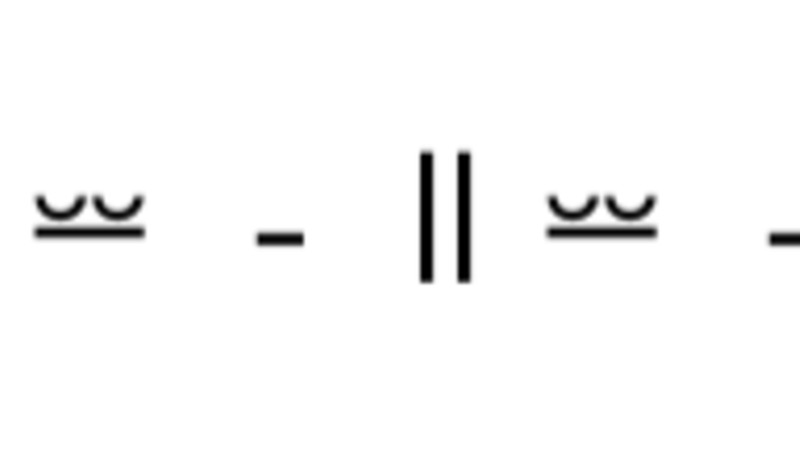
Boethius recounts in the prose passage preceding this metrum how as a free man he stood up for justice and the Senate. The fifth metrum opens with 24 lines praising God’s harmonious ordering of the universe before turning to a complaint against Fortune’s rule over human affairs. The whole ends with a supplication of 7 lines, imploring God to establish the same law on earth by which He rules the heavens. The verse lines are commonly 10 syllables in length but range from 9-11 syllables. They are composed of anapaestic dimeters in which each pair of short syllables can be replaced by a long and vice versa:
Versions of Almi prophetae:
Einsiedeln hymnal (s. xi) – ST 5491
Verona hymnal (s. xii) – ST 5492
Gaeta hymnal (s. xii) – ST 5493
(ST=Bruno Stäblein (ed.), Hymnen: Die mittelalterlichen Hymnenmelodien des Abendlandes, Monumenta Monodica Medii Aevi 1, Kassel: Bärenreiter, 1956)
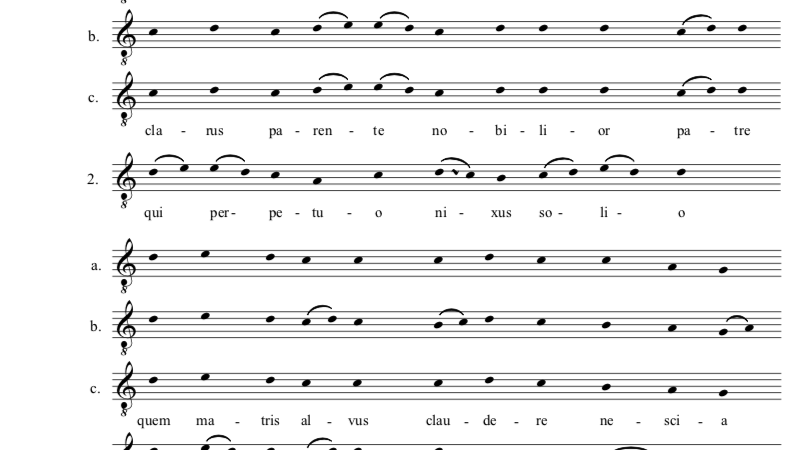
The version of the reconstructed melody given here was prepared in conjunction with Benjamin Bagby, who also collaborated in a series of creative practical experiments leading to the principles of reconstruction outlined above. Extending the melody over the remaining lines of the poem represented a considerable task. The main factor taken into consideration was the division of the text into three discrete sections, namely the opening hymn of praise (lines 1-24), the following complaint (lines 25-41), and the closing supplication (lines 42-48). Within these main divisions, an attempt was made to match melodic closure with main points of textual articulation through flexible patterns of melodic repetition within the indicated opening four-line melodic unit of return. In so doing, particular advantage was taken of the flexibility in the melodic tradition of Almi prophetae between a closed g and open a cadence at the end of the third line of the strophe.
For the wider notated tradition of O stelliferi conditor orbis, see Barrett, The Melodic Tradition, vol. I, pp. 174-8, and vol. II, pp. 201-2.