
Tunc me discussa (I:3). from the Cambridge Songs Leaf (MS Gg.5.35)
A pdf version of this explanation may be found here.
Neumes for the third metrum of book I survive only in the Cambridge Songs leaf (Cambridge, University Library Gg. 5. 35, fol. 442*r). The scarcity of notation is not surprising as this metrum is the only one in De consolatione philosophiae that is not presented as a song. Instead the story as narrated by the fictional Boethius continues from the preceding prose section into the metrum, where a moment of inner transformation is described as his decisive turn to begin the process of recovery.
The lyric meter is composed of dactylic elements: odd lines consist of hexameters and even lines are written in tetrameters. As with the setting of the elegiacs of Carmina qui quondam, the melodic profile recorded in the neumes implies behaviors associated with a psalm tone. The melody opens with a decorated intonation extending up to the fixed caesura in the opening line (Tunc me discussa). There follows a decorated pattern of recitation that extends into the second line (liquerunt nocte tenebrae/ Luminibus-), before a more elaborate figure over the syllables up to the caesura (-que prior). A melodic formula with some similarities to that found over syllables 3-5 of the first line follows after the caesura, which is now extended into a final cadence over the closing two syllables of the second line (rediit vigor).
The melodic profile of the opening intonation accords with am elaborate psalm tone 7. The version of tone 7 recorded for the Magnificat and Benedictus canticles in the Worcester Antiphoner (WOR 160) is given by way of comparison. The way that the melody appears to come to rest on the fourth degree of the scale at the caesura is consistent with the handling of tone 7 in Introits, where c’ is commonly established as a secondary center in tandem with the lower a. An even clearer model in terms of overall melodic profile and procedure is provided by the Hymn of the Three Boys (the Canticle of Azariah) as reproduced below from the twelfth-century Bellelay Gradual (POR 18). This text may only loosely be considered a hymnus in so far as it consists of bi-partite verses with a repeating melodic outline for each verse. It is treated as a canticle with its own flexibly adapted tone; the overall result is a series of similarly elaborated psalmodic verses, a practical solution for lines of unequal syllable count. The cadential elaboration is notable for the descent to the subfinal before the cadence to create a so-called Gallican cadence.
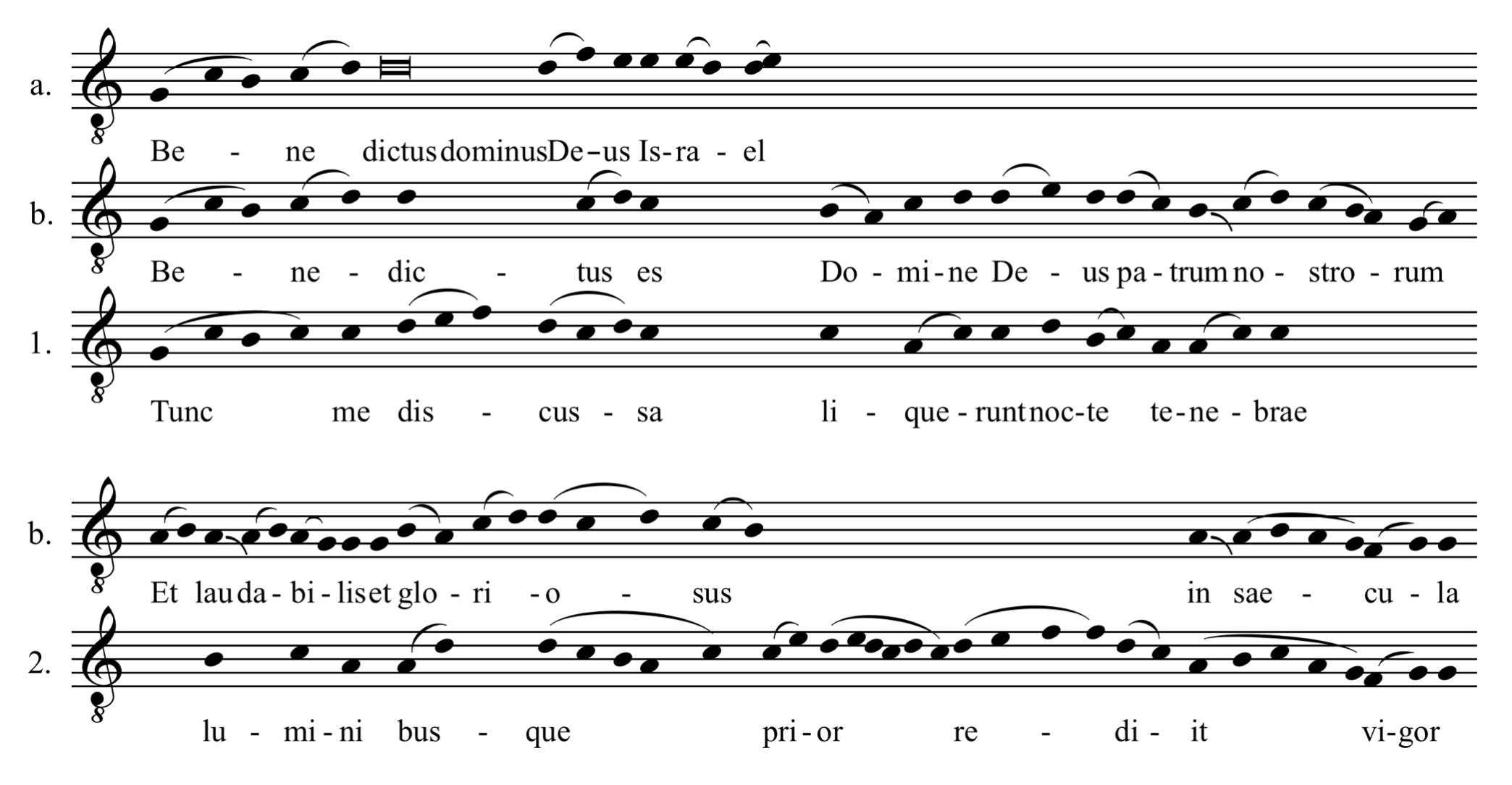
a. WOR 160, p. 442
b. POR 18, p. 372
A melody for the whole of Tunc me discussa may be proposed on the basis of the above reconstruction of the neumed opening couplet in the Cambridge Songs leaf. The version given here was prepared in conjunction with Benjamin Bagby, who also collaborated in a series of creative practical experiments leading to the principles of reconstruction outlined above.